Visiting Al Hoota Cave – Oman’s show cave

We love visiting show caves and make a point of seeking them out whichever country we are visiting. In Oman, the largest cave you can explore with ease is Al Hoota in Al Hamra, so obviously we had to go. And it’s well worth a visit!
Oman’s amazing geology

Now, I’m not a geologist. But I have met a few during our travels in Oman and they get very excited about its mountains, valleys and the forces of nature that created them.
Experts have aged Al Hoota Cave at between two and three million-years-old. Back then Oman was a very wet place. Water flowing through the sedimentary layers dissolved the limestone forming tunnels and eventually a cave now known to span 5km.

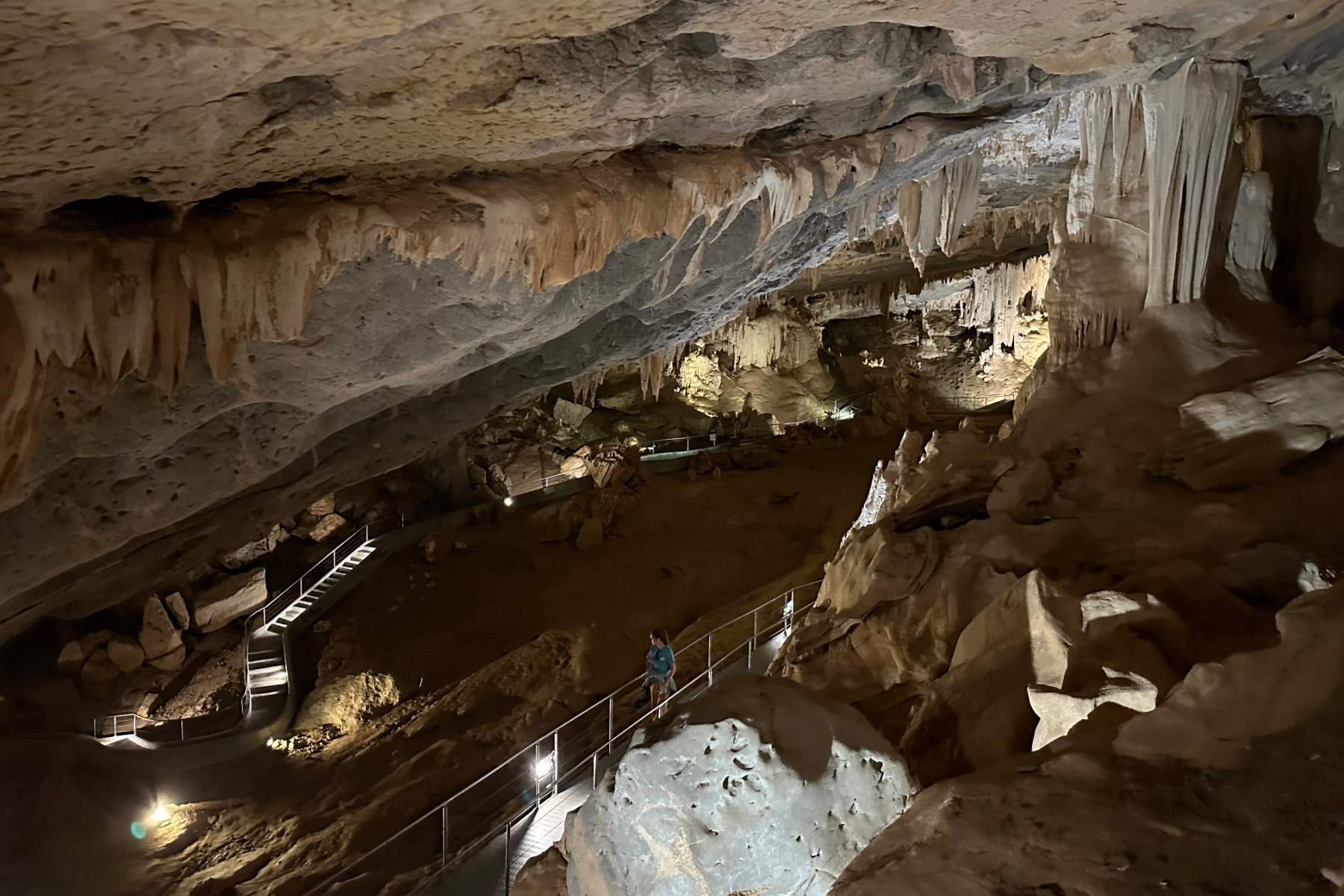
At one time Al Hoota was completely full of water. The pock marked roof got its holes from water corrosion – something we’ve not seen at other caves we have visited.
Despite its great age, the cave was only discovered in the 1960s when a goat herder from the nearby village of Al Hutah was looking for a lost animal.
After a period of exploration, Al Hoota – it’s tourist attraction name – opened in 2006 as the Arabian Peninsular’s first show cave. It closed between 2012 and 2016 for renovations but remains the largest cave you can visit in Oman and the wider Gulf region.
Al Hoota cave tours

Today you can explore 500 metres of the cave on a guided tour that takes between 45 minutes and an hour. Guides speak both Arabic and English.
A lot of the information provided by our guide was also available on signs around the cave’s one way system, but they were happy to answer questions.
The actual walk covers a distance of 850m along cement and metal walkways with 230 steps taking you up to the best views points in each chamber. Even though you are out of the sun and underground, expect humidity.

In the largest part of the caves you can see massive stalactites and stalagmites which have been coloured reddish by the minerals in the rock layers above.

A fun point of interest for younger visitors is the lion shaped stalagmite. Can you spot it in the picture above?

The furthest point for regular tourists is one of Al Hoota’s four underground lakes, which is home to a rare type of blind fish. The Garra Barreimaie have adapted to cave life by growing a layer of skin over their unnecessary eye balls.
For the more adventurous who want to explore the full length of the cave you can go on a caving tour from this lake. This is not for the faint-hearted and involves crawling through water pools of up to 800m in length, abseiling and braving temperatures of a very un-Omani 20°C.
Tours are run by trained caving leaders from Oman Explorers and must be booked directly with them.
Find out more about Oman’s mountains

Back at the visitor centre go up stairs for the Geological Exhibition which gives you an insight into how Oman was formed by the movement of the tech tonic plates that thrust the ocean floor and volcanic rocks upwards to form the Hajar Mountains.
There’s also more information about the species that live in the cave including bats, snails and those blind fish. The exhibition is relatively small so you don’t need much time here.
If you want to find out more about Oman’s natural history I can recommend a visit to Oman Across the Ages Museum near Nizwa.
Accessibility

We explored Al Hoota cave while my parents were visiting Oman. The most challenging part was walking from the main exhibition building to the tunnel which takes you deep into the caves. The electric train that used to transport visitors had been off line for some time.
You’ll be happy to know it’s no longer necessary to make this sweaty five minute hike.
Since our visit, the rails have been dismantled and a golf buggy service now whizzes visitors to the cave.
If you are visiting with children it is not possible to use a pushchair or buggy into the cave because of the steps. Leave these at the visitor centre.
Tips for visiting Al Hoota Cave

- Wear cool, loose conservative clothing that covers knees and shoulders. Flat shoes with a bit of grip are easiest for walking around. Flip flops may slip on the metal walkways.
- Children must be supervised at all times. Stepping off the walkway is dangerous.
- Despite what the website says, our guide told us you can take photos inside the cave but must not use a flash so as not to disturb bats and other creatures.
- There is a cafe and toilets in the visitor centre but not the caves.
When is the cave open?
The caves are open from 9am to 5pm, Sunday to Thursday throughout the year. The last tour is at 4pm. Contact the cave for up-to-date opening times during public holidays.
Tickets for Al Hoota Cave
You can only visit the cave with a guide and tours are run in timed slots. This is done to protect the wildlife in the caves. A maximum of 750 people can visit the cave each day.
We were able to buy tickets online, but the website is glitchy and the booking system is not hosted on a secure site. Thankfully it is possible to get walk-up tickets but you may need to wait for a space on a tour if it’s a busy day.
At the time of publication, ticket prices were 7.350 OMR for non-Omani adults and 3.675 OMR for non-Omani children aged over six. Kids under six can visit for free. There is a reduced rate for Omani nationals.
Where is Al Hoota?
Al Hoota Cave is a 35 minute drive from Nizwa or just over two hours from Muscat. The entrance is signposted from the main road. There’s plenty of parking in front of the main visitor centre.
There is no public transport to the cave so if you are not renting a car you’ll need a taxi or guide from Muscat or Nizwa. This can be quite costly.
Find out more about getting around in Oman.
We visited the cave from Nizwa as part of a day out that included lunch and a walk around the mountain village of Misfat al Abriyyin, which is half an hour further into the foothills of Jebel Shams.
Final thoughts on visiting the show cave
Whether you’re a fan of geology or just fascinated by the forces of nature, I highly recommend a visit to Al Hoota Cave if you are in Al Hamra. It’s an incredible look behind the scenes at the making of Oman, from the bottom of the sea to thousands of metres above it.
The new solution for getting guests to the cave entrance is also a welcome improvement.