Bahla Fort – handy things to know about this UNESCO attraction

Despite its UNESCO World Heritage site status, Bahla Fort is often overlooked by visitors in the favour of the more famous Nizwa Fort. But having visited both, Bahla is hands down my favourite.
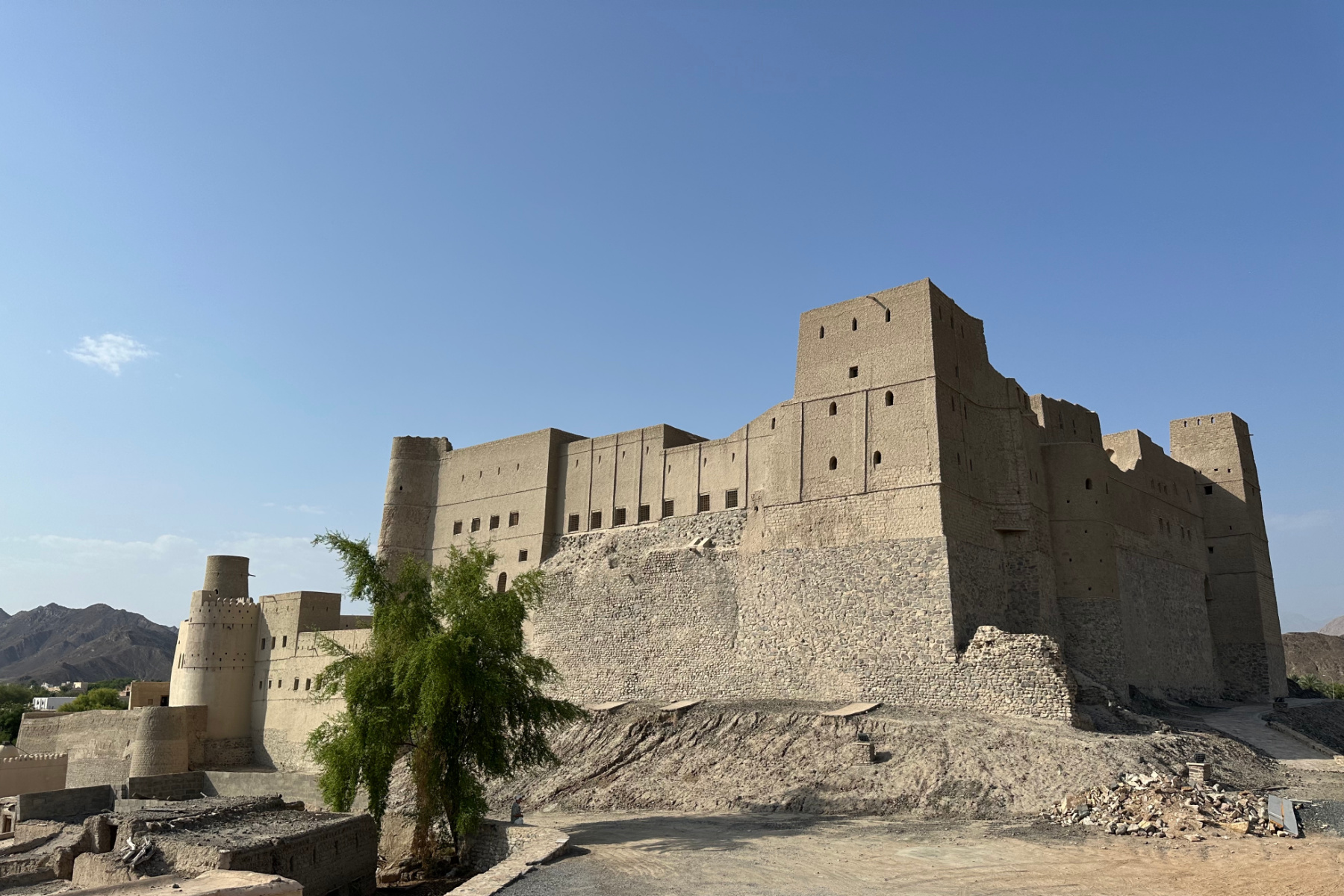
Positioned high on a hill overlooking an oasis of palms nestled in the northern Hajar Mountains, it is everything I expected of an Omani fortress designed to both protect and intimidate.
In this post I want to share with you the experience of visiting Bahla, how it compares to Nizwa and why it is definitely worth your time, particularly if you are on you way to Jebel Shams.
A fort worthy of a Medieval capital

Oman’s capital has moved around a fair bit over the years. The historic cities of Nizwa, Sohar and Rustaq have claimed the title at various times through the millennia. The capital has even been located in modern day Tanzania, which was once part of Oman’s wider empire.
Bahla earned the title thanks to the power of the Banu Nebhan tribe which ruled swathes of Oman between the 12th and 15th Centuries.
The city found importance because it was sat on a frankincense trade route and this precious resin warranted the very best defences. The Banu Nebhan kings built the fort and a wall around the city to protect it.
Catching the eye of UNESCO

It was in 1987 that Bahla Fort was added to the UNESCO World Heritage List as a place of historical and cultural significance – the first place in Oman to win this honour.
Bahla had caught UNESCO’s attention because recent restoration work ‘had not respected its authenticity‘. So, a plan was put in place to help preserve the fort using traditional construction methods and materials.
Visiting Bahla Fort today

Bahla is surprisingly a hidden gem considering its size and status. We had it almost to ourselves when visiting in my children’s February half term, at the peak of the tourist season.
Another welcome surprise for us as Oman residents was the very reasonable entrance fee of 2.5 OMR for adult expats, compared to 5 OMR at Nizwa Fort. Sorry, if you’re a tourist the entrance fee is 4 OMR.
We visited Bahla before a 2026 revamp was completed. Prior to this my only criticism the Fort was that there’s wasn’t much information about the place.
Well, someone was listening as the development project has added interactive information screens and displays to enhance the visitor experience.

If you have visited Nizwa you will already have a good idea of how an Omani fort works thanks to the extensive exhibitions and working gardens there.
Oman Across the Ages Museum at Manah near Nizwa and the National Museum in Muscat are also a good places to stop to read up on Bahla’s history.
Having been to both I’ve picked up that the fort was built in three phases. First came the old fort ‘al-Qasabah’ which is on the right once you have walked through the gate house. This was completed in the early 1600s.
Next came ‘Bait al-Jabal’ (the mountain house) in the 18th Century and ‘al-Bait al Hadith’ (the new house) in the 19th Century. Each period of development coincided with the dates that Bahla was Oman’s capital city.
The little bit of history I’ve shared above will hopefully enrich your visit too.

There are reception rooms, a small mosque and date stores, defensive murder holes and loop holes through which guards could fire on attackers.

One of the most modern additions to the fort is Al Bait Al Hadeeth. This modern house was built in the 19th Century for the governor at the time.

The beauty of Bahla is that you are free to explore the maze of rooms, battlements and towers without falling over too many other people. If you’ve already been to Nizwa Fort you’ll know what I mean – the competition is strong for the best Instagram snaps there.
The views of the oasis and mountains beyond are brilliant. You can also see some of the city wall that still encircles modern Bahla.
More things to see and do
As well as exploring the ancient battlements and rooms, here’s the other things to do at the Fort:
Try Omani bread

In the courtyard outside the Fort’s cafe we ordered Omani bread – very much like a pancake – with honey and laban (yogurt). It’s delicious!
Pottery

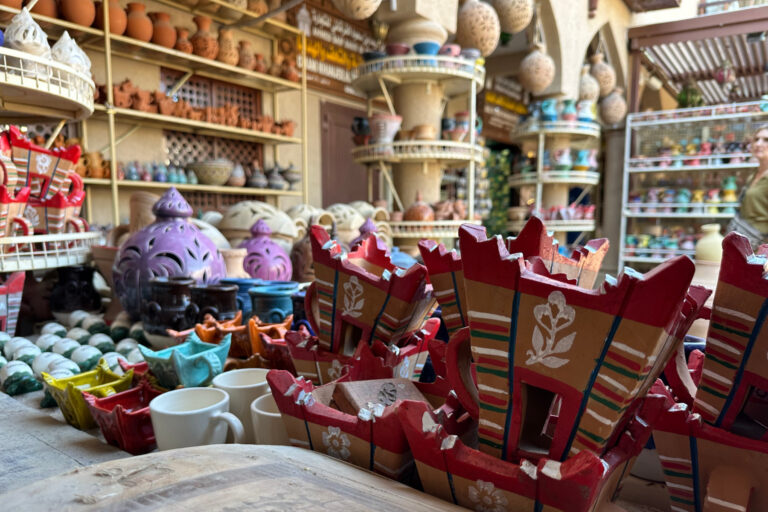
The oasis town of Bahla is famous for its pottery and the fort has its own workshop where you can buy and make your own clay souvenir. If you need a break from the Omani sun this is a good place to cool down too!
Festivals
In the cooler winter months, Bahla Fort hosts evening entertainment, pop up souqs and art exhibitions. Keep an eye on the Fort’s Instagram account for details.
More tips for visiting
- The whole fort is open to the elements, so come preferred with cool, loose clothing, sun cream and hats. Flat shoes are easiest for walking around.
- Wear conservative clothing that covers knees and shoulders.
- There are lots of steps, so if you are visiting with small children who are unable to walk themselves bring a child carrier rather than a push chair.
- Keep a close eye on children at all times. There are lots of drops without barriers.
- Card payments are accepted for entry to the Fort but bring some cash to pay the ladies making Omani bread. You can also buy small gifts and perfume from local ladies inside the Fort
- There are bathrooms with Western-style toilets in the Castle but bring your own toilet paper and dispose of it in the bin.
- There is a cafe in the fort selling hot and cold drinks, cake and ice creams.
When is Bahla Fort open?
The Fort is open every day from 8am until 7pm. Opening hours may vary during Ramadan and Eid. Check the fort’s website for updates.
What is the admission price?
Here’s all of the prices:
| Visitor | Entry price |
| Omani or GCC adult | 1.5 OMR |
| Omani or GCC child (aged 6 to 12) | 500bz |
| Oman resident adult | 2.5 OMR |
| Oman resident child (aged 6 to 12) | 1 OMR |
| Tourist adult | 4 OMR |
| Tourist child (aged 6 to 12) | 2 OMR |
| All children under six-years-old | FREE |
How to get there
Bahla is a two hour drive from Muscat. Take Route 15 out of the city and enjoy driving gradually upwards between the mountains.
Take a right at Khamilah (there’s an Oman Oil petrol station just before the junction) . This road takes you all the way to Bahla. You’ll see the fort on the horizon as you approach.
Free parking is available on the roads around the fort.
Final thoughts on Bahla Fort

I’ve already given away the fact that Bahla is my favourite Omani fort. It feels authentic – like the governor and his staff have just moved out. And the recent work to improve the information available to visitors can only enhance the experience.
It’s also much less busy and has nowhere near the number of visitors drawn to the tourist hubs of Muttrah in Muscat and neighbouring Nizwa. Yet!
We have visited Bahla as a stop off on the way to do the Balcony Walk on Jebel Shams and a stay at the mountain village of Misfat Al Abriyeen.